
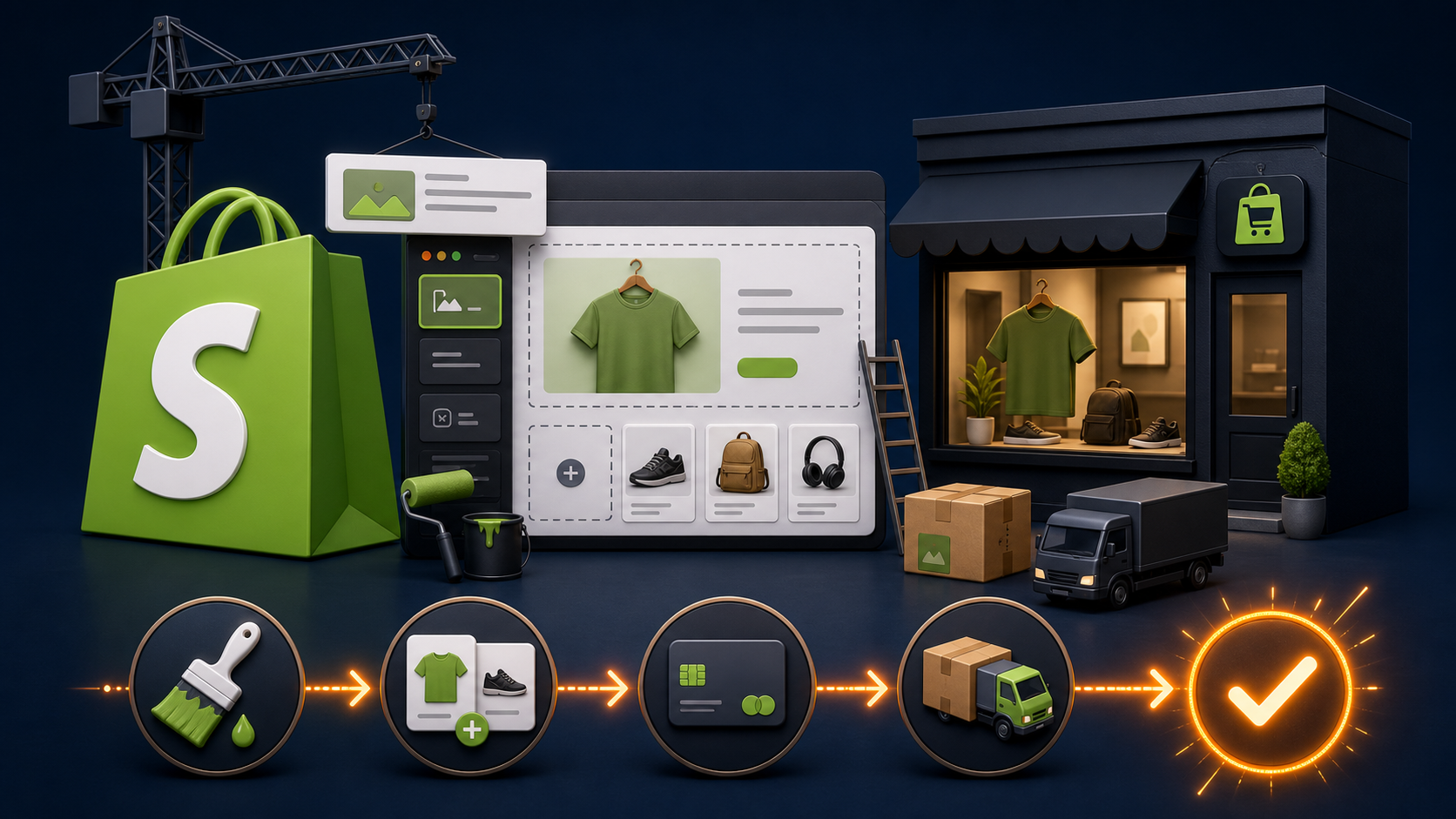
Complete Shopify Store Setup Guide: Launch Your Online Shop in 2026
How do you set up a Shopify store? Sign up for a free trial, choose a plan (Basic at $39/month suits most beginners), pick a theme, add products with keyword-rich descriptions, configure payments and shipping, install 2 - 3 essential apps, and set your SEO title tags. A basic store can be live in 1 - 3 hours.
Reading time: 8 minutes | Skill level: Beginner-friendly | Time to complete: 1 - 3 hours
Whether you're an aspiring entrepreneur or a small business owner ready to sell online, setting up a Shopify store doesn't have to be overwhelming. This guide walks you through every step - from choosing the right plan to launching your first product - so you can go from zero to live store in a single afternoon. Follow this practical tutorial to build, design, and optimize a high-converting Shopify store in 2026.
1. Choose the Right Shopify Plan
Start your Shopify store setup for ecommerce beginners by signing up for Shopify's free trial. This gives you full access to explore the platform before committing to a paid plan.
Shopify offers three core plans suited to different stages of business growth. Here's how they compare:
| Plan | Monthly Price (USD) | Transaction Fee (w/out Shopify Payments) |
Staff Accounts | Best For |
|---|---|---|---|---|
| Basic Shopify | $39 | 2 % | 2 | New stores & solo entrepreneurs |
| Shopify | $105 | 1 % | 5 | Growing stores with a small team |
| Advanced Shopify | $399 | 0.5 % | 15 | Scaling stores needing advanced reporting |
Our recommendation for beginners: Start with Shopify Basic. It includes everything you need to launch - unlimited products, a full online store, discount codes, and 24/7 support. You can always upgrade once your monthly revenue grows. The main difference between Shopify Basic and Advanced is reporting depth, shipping discounts, and transaction fees - features that matter more as you scale.

Custom Domain Setup
Before you go live, connect a custom domain to your store. You can purchase a domain directly through Shopify or use a third-party registrar like Namecheap or GoDaddy. To connect an external domain, go to Settings > Domains in your Shopify admin and follow the DNS configuration instructions. Set your custom domain as the primary domain and enable automatic redirects so visitors always land on the right URL.

2. Select and Customize a Shopify Theme
Head to Online Store > Themes in your admin. Free themes like Dawn are lightweight and fast, while premium themes from the Shopify Theme Store offer advanced layouts and conversion-focused features.
For most beginners, the Dawn theme is the best Shopify theme for ecommerce to start with. It's fast, mobile-ready, and built on Shopify's latest Online Store 2.0 framework. Here's how to customize it:
- Go to Online Store > Themes and click Customize next to your active theme.
- Use the theme editor to update your Header: add your logo and set your navigation menu.
- Customize the Hero Banner on your homepage with a high-quality image and a clear call-to-action button.
- Add a Featured Collections section to highlight your best product categories.
- Go to Theme Settings > Colors to set your brand color palette.
- Go to Theme Settings > Typography to set your font choices consistent with your brand style guide.
- Add an Announcement Bar at the top of the page to promote free shipping thresholds or limited-time offers.
- Click the mobile preview icon to check how your store looks on smaller screens before saving.

Theme Customization Checklist
- Add a clear About Us page and Contact page.
- Upload a high-resolution logo: PNG, transparent background.
- Set color palette and typography consistent with your brand style guide.
- Optimize all images with descriptive
alttext for accessibility and SEO. - Preview the store on mobile within the theme editor and confirm the checkout flow works on small screens.
Legal and Trust Pages
Shopify can auto-generate policy pages for you. Go to Settings > Policies to create your Privacy Policy, Terms of Service, Refund Policy, and Shipping Policy. These pages are legally required in most jurisdictions and are essential trust signals for both customers and Google.
3. Add Products and Organize Collections
Navigate to Products > Add product. Fill in:
- Product title and keyword-rich description (include phrases such as "best running shoes in Pakistan"). For tips on writing SEO-optimized copy, see our guide on how to write SEO product descriptions on Shopify.
- SKU, barcode, and inventory quantity.
- High-quality images (1500 × 1500 px recommended).
- Price and Compare-at-price for psychological anchoring.
Create smart collections like
/collections/best-sellers or
/collections/new-arrivals to improve product discovery.
4. Configure Payments, Shipping, and Taxes
Enable Shopify Payments for instant credit card processing and lower fees. Add PayPal, Cash on Delivery, or local gateways relevant to your market.
Setting Up Shopify Payments
Go to Settings > Payments and click Complete account setup under Shopify Payments. You'll need to provide your business details, banking information, and verify your identity. Once active, Shopify Payments eliminates third-party transaction fees and supports multiple currencies - ideal for stores selling internationally.
- Set shipping zones with weight-based or value-based rates.
- Activate real-time carrier rates if you use carriers like DHL or FedEx.
- Review tax settings, especially if you sell internationally.
5. Install Must-Have Shopify Apps for New Stores in 2026
Open the Shopify App Store and add these top picks. Each app solves a specific growth problem - but be selective: installing too many apps can slow your store's page speed and hurt SEO rankings. Stick to 4 - 6 core apps to start.
To find apps, go to Apps > Shopify App Store from your admin dashboard. Use the search bar or browse by category (e.g., Marketing, Store Design, Shipping).
- SEO Manager - improves meta tags and schema. Free and paid options available.
- Judge.me - collects product reviews and boosts trust. Has a generous free plan.
- Klaviyo - advanced email marketing and automated flows. Free up to 250 contacts.
- ReConvert - post-purchase upsells to raise average order value (AOV). Paid with free trial.
6. Optimize Your Shopify Store SEO for Higher Visibility
Good SEO means organic traffic and free sales. Use this Shopify SEO optimization checklist to get your store ranking fast:
Keyword Research
Start with keyword research using tools like Google Keyword Planner and Ahrefs. Target a mix of high-volume terms (e.g., "Shopify store setup") and long-tail phrases (e.g., "how to set up a Shopify store for beginners").
On-Page SEO
- Write unique meta titles and descriptions that include phrases like "how to create a Shopify store" and "Shopify store setup checklist".
- Clean URLs:
/collections/mens-sneakersinstead of/12345. - Use H1, H2, and H3 heading tags with your target keywords included naturally.
- Add descriptive
alttext to every product image.
Technical SEO
- Submit your XML sitemap to Google Search Console. Your Shopify sitemap is automatically generated at
yourstore.myshopify.com/sitemap.xml. In Google Search Console, click Sitemaps in the left menu, paste your sitemap URL, and click Submit. - Check your store's page speed using Google PageSpeed Insights. Compress all images before uploading and limit the number of installed apps to keep load times fast. Core Web Vitals are a Google ranking factor - a slow store hurts both SEO and conversions.
- Enable Google Analytics 4 to track visitor behaviour and traffic sources.
Content Marketing
Shopify includes a built-in blogging feature. Use it to publish keyword-rich articles that attract organic traffic. Go to Online Store > Blog Posts > Create blog post to get started. A consistent content strategy compounds over time and reduces your dependence on paid ads.
For an advanced walkthrough, see our Shopify SEO Checklist guide.
7. Preview, Test, and Launch Your Store
Before going live:
- Run test orders using Shopify's Bogus Gateway.
- Test checkout in multiple currencies and shipping scenarios.
- Enable Google Analytics 4 and Google Tag Manager.
- Disable storefront password, then announce your launch on social media.
Post-Launch Checklist
Once your store is live, your work is just beginning. Here's what to do in your first week:
- Monitor traffic in Google Analytics 4 and track which pages attract the most visitors.
- Log in to Google Search Console and confirm your sitemap has been indexed.
- Share your store on social media platforms - Instagram, Facebook, TikTok, and Pinterest are popular for ecommerce.
- Start building your email list with a welcome popup or a launch discount offer.
- Process your first orders and review your fulfilment workflow end to end.
Frequently Asked Questions
How long does it take to set up a Shopify store?
A basic Shopify store can be set up in 1 to 3 hours. A fully optimized store with custom branding, a complete product catalog, and integrated apps typically takes 1 to 3 days.
What is the best Shopify plan for beginners?
For most beginners, Shopify Basic at $39/month is the best starting point. It includes unlimited products, discount codes, and 24/7 support - everything you need to validate your store before upgrading.
Can I use Shopify without any coding knowledge?
Yes. Shopify is designed to be used without any coding. The theme editor, drag-and-drop page builder, and intuitive admin panel let you build a professional store entirely through point-and-click interfaces.
Is Shopify free to start?
Shopify offers a free trial that gives you full access to the platform. After the trial period ends, you'll need to select a paid plan to keep your store active and accessible to customers.
What is the difference between Shopify Basic and Advanced?
The main differences are reporting depth, shipping discounts, and transaction fees. Shopify Advanced includes advanced report builder features, calculated shipping with third-party carriers, and a lower transaction fee (0.5% vs 2% on Basic). Advanced is best suited to stores generating consistent monthly revenue above $10,000.
Do I need to install apps on Shopify to run a store?
No. Shopify's core features cover products, payments, shipping, and basic SEO out of the box. Apps extend functionality - but you can launch a fully operational store without any third-party apps installed.
How do I get my first sale on Shopify?
The fastest paths to a first sale are: sharing your store with your personal network, running a small paid social media ad, listing products on Google Shopping, or offering a launch discount to your email subscribers. Organic SEO takes longer but compounds over time.
Does Shopify handle taxes automatically?
Shopify can automatically calculate and apply tax rates based on your store's location and your customers' locations. Go to Settings > Taxes and duties to configure your tax settings. If you sell internationally, review each region's tax rules carefully or consult a tax professional.
